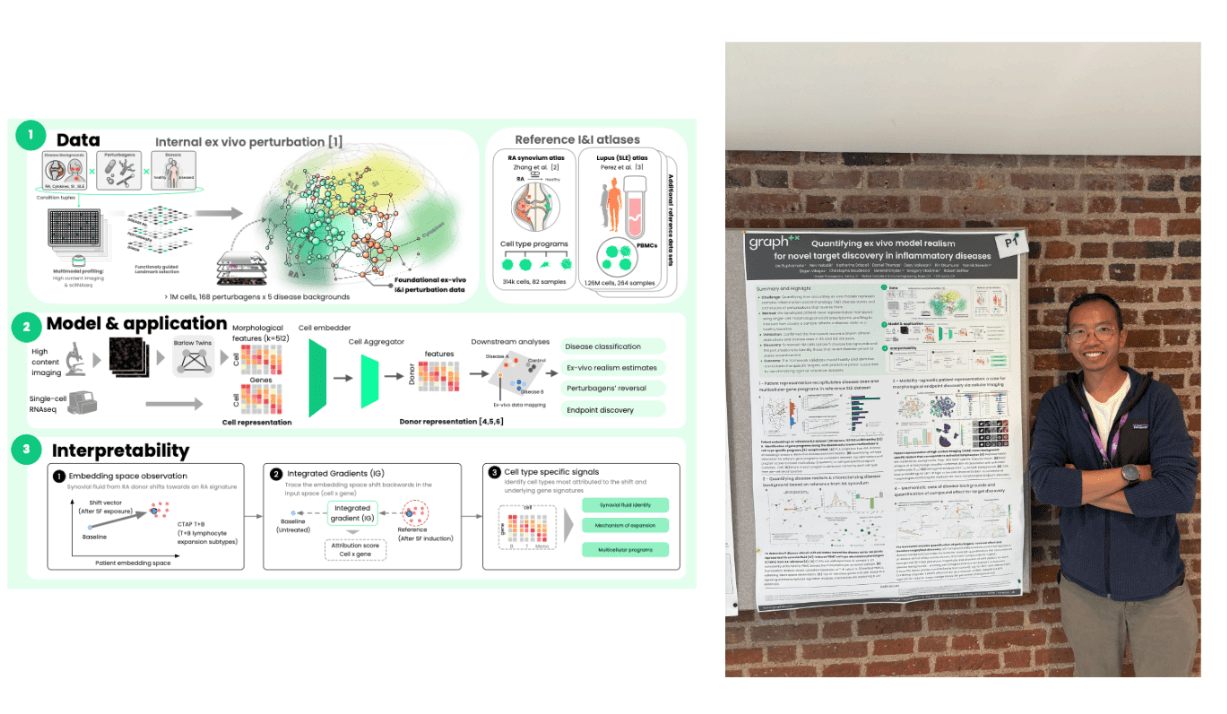
Quantifying ex vivo model realism for novel target discovery in inflammatory diseases
A modality-agnostic patient representation
The framework embeds single cells from high-content imaging and single-cell RNA-seq into a donor-level representation for each condition tuple of donor, disease background and perturbagen. Internal ex vivo perturbation data (more than 1M cells, 168 perturbagens across 5 disease backgrounds, including RA synovial fluid, sterile inflammation, IL-10 and Treg induction) is mapped into the same space as reference I&I atlases. The shared embedding supports disease classification, ex vivo realism estimates, perturbagen reversal quantification and endpoint discovery.
Validation against reference disease axes
On the SLE reference, PCA of the donor embedding reveals a distinct disease axis from healthy. Per-cell attribution recovers known multicellular programs such as interferon signaling and cell-type-specific programs such as cytotoxic CD8, reproducing published multicellular immune programs.
Against the RA synovium cell type abundance phenotypes, RA synovial fluid consistently shifts healthy PBMCs toward the T+B lymphocyte-enriched subtype, confirmed orthogonally by composition analysis showing T and B cell expansion. Integrated gradients trace the shift back to cell x gene space, identifying BCR signaling and transcriptional regulation modules in B cells as the mechanistic basis of the expansion.
Quantifying perturbagen reversal for target discovery
For each background, compound-induced shift vectors are decomposed into aim relative to the disease axis and push magnitude, yielding a reversal fraction against an empirical null. This separates reversers, which move donor profiles toward control, from inducers, which move them away, and flags inert compounds. In the APO-SAA sterile inflammation background, Belnacasan (caspase-1 inhibitor, NLRP3 effector) scores as a reverser while BMS-986299 (NLRP3 agonist) scores as an inducer, consistent with known mechanism.
Together this turns ex vivo screening into a quantitative target validation step: model realism can be benchmarked, and every perturbagen carries a reversal readout with mechanism traced to cell type and gene level.
See the whole poster here.